22 Jun 2026
Connecting Compliance Measures With Game Variety in Digital Casino Portfolios

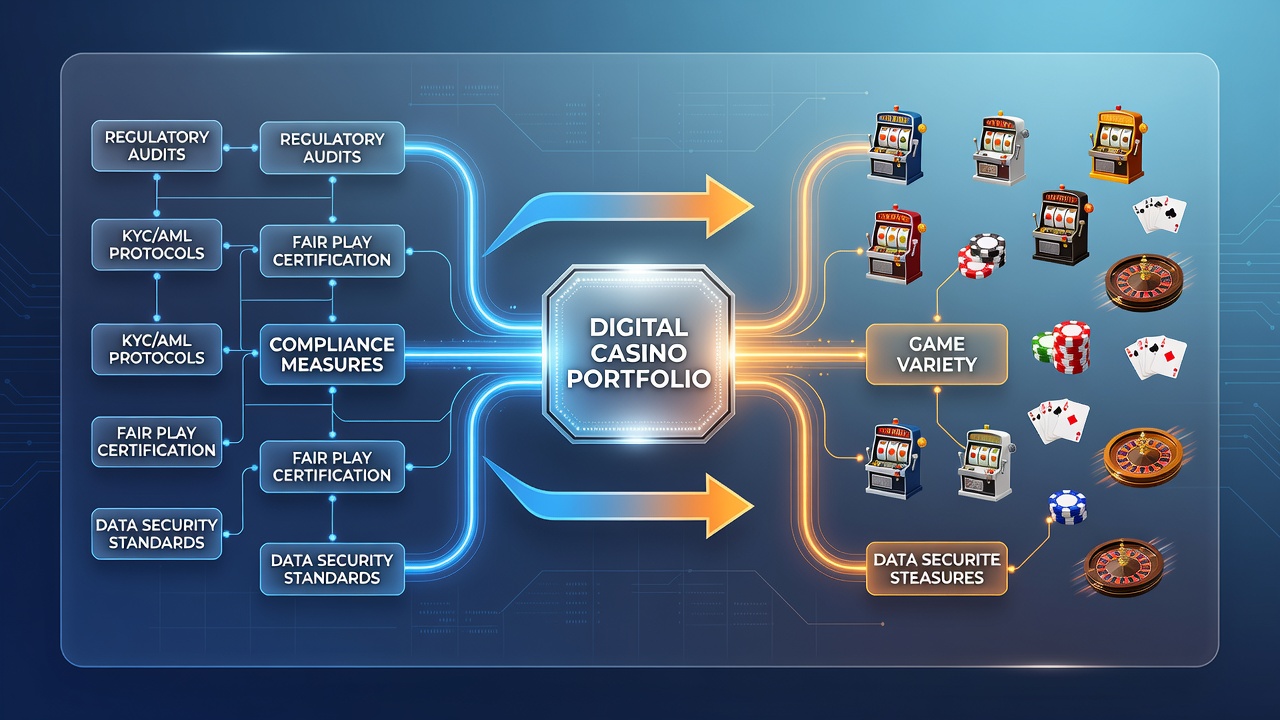
Digital casino operators manage extensive game libraries that span slots, table games, live dealer experiences, and instant-win formats, yet every title must operate inside layers of regulatory oversight that govern player access and transaction flows. Compliance systems now sit at the core of portfolio design because age verification, anti-money laundering checks, and responsible gambling tools apply uniformly while adapting to the distinct risk profiles each game category presents.
Regulatory Structures Shape Available Game Types
Regional licensing authorities establish rules that determine which games operators can offer and under what conditions, and these frameworks have grown more granular since 2024. Jurisdictions such as the Alcohol and Gaming Commission of Ontario require operators to segment game access according to verified player status, which means high-volatility slots or progressive jackpots may carry additional session limits that standard table games avoid. Data from the commission shows that portfolios in Ontario expanded by 18 percent in approved titles between 2023 and 2025, yet each new addition underwent automated compliance scoring before launch. Similar patterns appear in New Jersey where the Division of Gaming Enforcement maintains a public database of certified RNG titles; operators must flag any game whose return-to-player variance exceeds defined thresholds, and those flags trigger real-time monitoring dashboards.
European markets follow comparable logic. The European Gaming and Betting Association published figures in early 2026 indicating that member operators reduced average portfolio size by 12 percent in jurisdictions that introduced per-game responsible gambling triggers, yet overall player engagement remained stable because remaining titles received enhanced compliance integrations. These adjustments illustrate how regulators influence variety without eliminating it, because compliance layers allow operators to retain breadth while satisfying stricter controls.
Technical Systems Bridge Compliance and Game Delivery
Modern platforms deploy centralized compliance engines that communicate directly with game servers, and this architecture supports wide variety without creating separate verification workflows for each category. When a player selects a live blackjack table, the system cross-references the same identity token used for slots, then applies any jurisdiction-specific stake caps or cool-down periods in milliseconds. Such integration reduces friction, yet it also generates detailed audit trails that regulators examine during routine inspections.
Operators have begun embedding geo-fencing and device fingerprinting at the game-launch level rather than the account level, which permits granular control. A player located in a restricted zone might access classic three-reel slots while live dealer tables remain unavailable until location data updates. Research conducted by the University of Nevada’s gaming laboratory in 2025 documented a 27 percent drop in compliance-related session interruptions after operators adopted these per-game controls, demonstrating measurable efficiency gains across diverse libraries.
June 2026 Updates and Portfolio Adjustments
Regulatory calendars point to several changes taking effect in June 2026 that will further link compliance processes with game variety decisions. Multiple Canadian provinces plan to introduce standardized player-risk scoring models that classify titles according to session length and bet velocity, and operators have already begun pre-certifying games under these forthcoming rules. Early submissions indicate that instant-win formats will face tighter velocity thresholds than video poker variants, prompting some portfolios to rebalance toward slower-paced titles that align more easily with the new scoring matrix.
Industry observers note that these upcoming requirements build on existing patterns rather than replace them. Portfolios that already maintain modular compliance tags for each game have reported shorter recertification timelines, which allows faster rollout of new content while preserving regulatory standing. The approach also supports cross-border expansion because the same tagging system can accommodate differing regional parameters without requiring separate code branches for each market.
Practical Examples From Operating Markets
Take one European operator that expanded its live casino section in 2025 while maintaining full compliance coverage across all tables. The company applied session timers and loss-limit prompts directly inside the dealer interface rather than through separate pop-ups, and player retention metrics showed no measurable decline compared with pre-expansion levels. Similar tactics appear in Australian-facing platforms where regulators require separate audit logs for each game type; operators that unified those logs under a single compliance layer reduced manual review hours by roughly one-third according to internal efficiency reports.
Another case involves a North American platform that introduced crash-style games alongside traditional slots. Compliance teams mapped the new format’s rapid bet cycles to existing velocity monitoring rules, then added an automated flag that pauses play after a defined number of consecutive rounds. This integration allowed the operator to launch the title without creating an entirely new oversight workflow, and subsequent audits confirmed that the same anti-money laundering screening applied uniformly across both legacy and newer game categories.
Conclusion
Compliance measures and game variety function as interdependent elements within digital casino portfolios rather than opposing forces. Regulatory requirements establish boundaries that operators navigate through technical architecture, and the resulting systems permit broad libraries while satisfying oversight demands. As June 2026 approaches, platforms that maintain flexible tagging and unified monitoring stand positioned to absorb new rules with minimal disruption to content offerings. The pattern holds across jurisdictions because the underlying principle remains consistent: verification, monitoring, and access controls travel with the player, not with any single game, which preserves variety under evolving regulatory conditions.